The market for eyewear tech is likely to grow.
Presbyopia, an age-related condition that makes it harder to focus on things close to you, is projected to become more common over time as the world's population ages. And myopia, or short-sightedness, is also on the rise.
Spectacles have remained largely the same for decades. Bifocal lenses – in which a lens is split into two regions, usually for either near- or far-sightedness – require the wearer to direct their vision through the relevant region, depending on what they want to look at, in order to see clearly.
Varifocals do a similar job but the transitions are much smoother.
In contrast, auto-focus lenses promise to adjust part or all of the lens spontaneously, and even accommodate the wearer's changing eyesight over time.
"The first lenses that we produced were horrible," admits Mr Eiden, candidly.
Those early prototypes were "hazy", he says, and with the lens quality noticeably poor at its edges.
But newer versions have proved promising in tests, says Mr Eiden. Participants in the company's trials have been asked, for example, to read something on a page, then look at an object in the distance, to see whether the glasses respond smoothly to the transition.
Mr Eiden says that the eye tracking device within the spectacles cannot determine exactly what a wearer is looking at, though certain activities such as reading are in principle detectable because of the nature of eye movements associated with them.
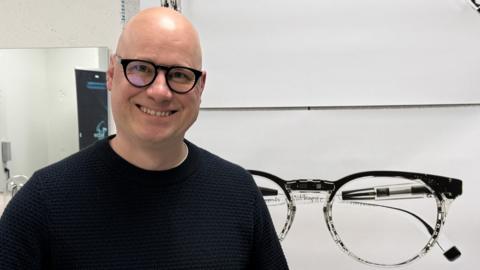
Since such glasses respond so closely to the wearer's eye behaviour, it's important the frames fit well, says Emilia Helin, product director.
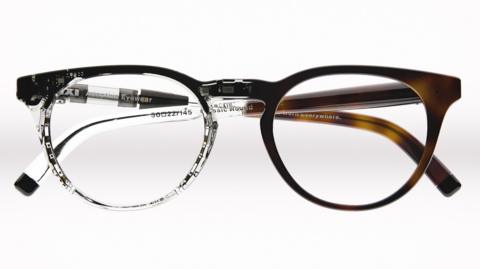
IXI's frames are adjustable but not to a great degree, given the delicate electronics inside, she explains: "We have some flexibility but not full flexibility." That's why IXI hopes to ensure that the small range of frames it has designed would suit a wide variety of faces.
The small battery secreted inside IXI's autofocus frames should last for two days, says Mr Eiden, adding that it's possible to recharge the specs overnight while the wearer is asleep.
But he won't be drawn on a launch date, which he intends to reveal later this year. As for cost, I ask whether £1,000 might be the sort of price tag he has in mind. He merely says, "I'm smiling when you say it but I won't confirm."