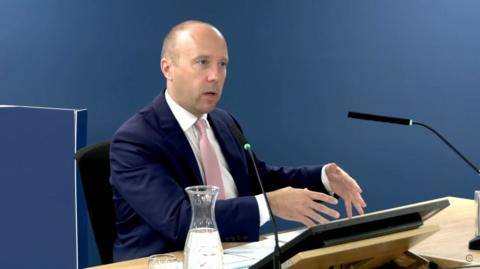
Questioned by Ms Carey, Mr Hancock acknowledged the discharge policy was an "incredibly contentious issue".
But he added: "Nobody has yet provided me with an alternative that was available at the time that would have saved more lives."
And he told the inquiry: "It's the least-worst decision that could have been taken at the time."
When the pandemic hit early in 2020, hospital patients were rapidly discharged into care homes in a bid to free up beds and prevent the NHS from becoming overwhelmed.
However, there was no policy in place requiring patients to be tested before admission, or for asymptomatic patients to isolate, until mid-April.
This was despite growing awareness of the risks of people without Covid-19 symptoms being able to spread the virus.
As his seventh and likely final appearance at the inquiry drew to a close, Mr Hancock admitted his overstretched department was "unbelievably busy, responding to the biggest civil emergency in 100 years".
In sometimes tense exchanges, he fielded questions from Kate Beattie representing disabled people's organisations and Pete Weatherby, barrister for Covid-19 Bereaved Families for Justice UK.
Mr Weatherby asked whether Mr Hancock had used the lack of "levers" available to him to act on Covid at the start of the pandemic as "an excuse for things when they went wrong".
"This is a very easy thing to say with hindsight," Mr Hancock responded.
"The reality of the situation is that I had to act with the tools that I had and that's what I did, and drove the life-saving effort to make sure things weren't even worse than they were."
Elsewhere, in response to wide-ranging questioning, Mr Hancock described the concept of blanket 'do not attempt resuscitation' orders as "abhorrent".
He said he only saw this happen once "and we jumped on it".
If that policy was more widespread, he said: "It did not come to my attention and, if it did happen, it's totally unacceptable."
Mr Hancock said the social care sector "was badly in need of and remains badly in need of reform", adding that in the event of another pandemic, he feared the situation had become "worse not better".
Lawyer Nicola Brook said Mr Hancock knew at the time that many care homes did not have the ability to isolate people who would be discharged from hospital, and that Covid was airborne.
"It's frankly ridiculous and insulting that he says they tried to throw a protective ring around care homes when his department's policies caused Covid to spread like wildfire amongst society's most vulnerable loved ones," she said.