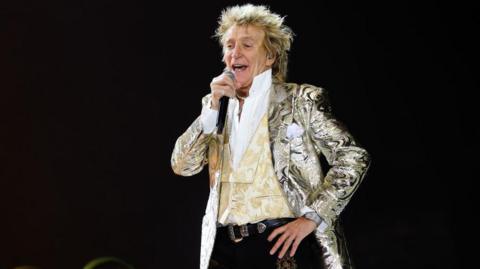
We're talking to the star about a month before Glastonbury at the Devonshire, a relaxed, old-school boozer just off Picadilly Circus that's become the favoured haunt of everyone from Ed Sheeran to U2.
It's a bit too early for a drink, though, so Sir Rod orders up a venti coffee, shooing away an over-eager assistant who attempts to stir in his sugar.
He's dressed in a cream jacket and black jeans, which sit above the ankle to show off his box-fresh, zebra-striped trainers. His white shirt is unbuttoned far enough to display a diamond-encrusted necklace with the crest of his beloved football club, Celtic.
And then there's the hair. A bleached blonde vista of windswept spikes, so famous that it earned a whole chapter in the singer's autobiography.
Steve Marriott of The Small Faces once claimed that Sir Rod achieved this gravity-defying barnet by rubbing mayonnaise into his scalp, then rubbing it with a towel.
This, says the musician, is utter "bollocks".
"Nah, nah, nah. I used to use sugared hot water, before the days of hair lacquer. And I couldn't afford hair lacquer, anyway."
But what really sets Sir Rod apart is that voice.
Raspy, soulful, raw and expressive, he's one of rock and roll's best interpretive singers. There's a reason why his covers of Cat Steven's First Cut Is The Deepest or Crazy Horse's I Don't Wanna Talk About It have eclipsed the originals.
So it's a surprise to learn that he was discovered not for his vocals, but his harmonica skills.
That fateful night in 1964, he'd been at a gig on Twickenham's Eel Pie Island, and was drunkenly playing the riff from Holwin' Wolf's Smokestack Lightnin' while he waited for the train home, when he was overheard by influential blues musician Long John Baldry.
"As he described it, he was walking along platform nine when he noticed this pile of rubble and clothes with a nose pointing out," Sir Rod recalls.
"And that was me playing harmonica."
At the time, he "wasn't so sure" about his singing voice. But, with Baldry's encouragement, he started to develop his signature sound.
"I wanted to always sound like Sam Cooke and Otis Redding, so that's the way I went," he says. "I suppose I was trying to be different from anybody else."