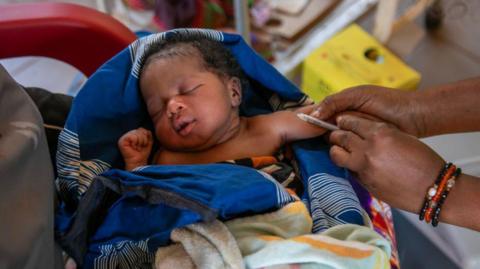
The global childhood vaccination programme has been a huge success.
Since 1974, more than four billion children have been vaccinated, preventing an estimated 150 million deaths worldwide.
In nearly half a century until 2023, researchers say vaccine coverage doubled.
But since 2010 progress has stagnated, to the extent that there are now wide variations in vaccine coverage around the world.
A study, published in the medical journal The Lancet, says measles vaccinations have declined in nearly 100 countries.
The Covid-19 pandemic made things even worse, because of disruption to vaccine programmes during lockdowns.
By 2023, there were nearly 16 million children who had not had any childhood vaccinations – most of them in sub-Saharan Africa and south Asia.
Study author Dr Jonathan Mosser, from the Institute for Health Metrics and Evaluation at the University of Washington, in the United States, says large numbers of children remain under-vaccinated and un-vaccinated.
"Routine childhood vaccinations are among the most powerful and cost-effective public health interventions available, but persistent global inequalities, challenges from the Covid pandemic, and the growth of vaccine misinformation and hesitancy have all contributed to faltering immunisation progress," he said.
Dr Mosser said there was now an increased risk of outbreaks of diseases like measles, polio and diphtheria.
All children should benefit from life-saving immunisations, he added.
Wide discrepancies remain between vaccination rates in wealthier and lower-income countries.
But the report's authors warn that vaccination rates have fallen in Europe, the US and other wealthy countries too.