Wubi News

First celestial image unveiled from revolutionary telescope

2025-06-23 16:00:07
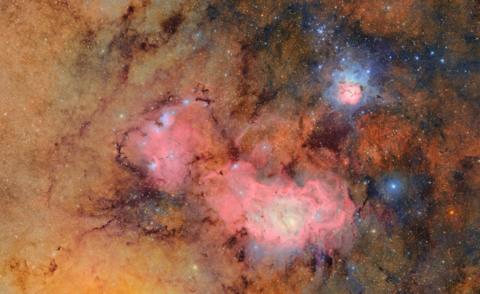
The first image revealed by the Vera Rubin telescope shows the Trifid and Lagoon nebulae in stunning detail

A powerful new telescope in Chile has released its first images, showing off its unprecedented ability to peer into the dark depths of the universe.

In one picture, vast colourful gas and dust clouds swirl in a star-forming region 9,000 light years from Earth.

The Vera C Rubin observatory, home to the world's most powerful digital camera, promises to transform our understanding of the universe.

If a ninth planet exists in our solar system, scientists say this telescope would find it in its first year.

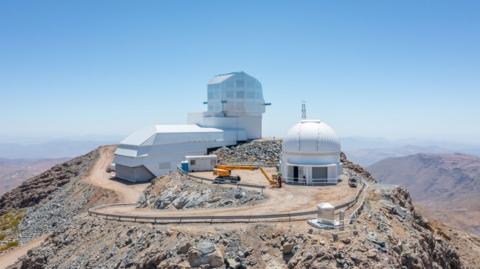
Rubin Observatory and the Rubin Auxiliary Telescope in Cerro Pachón in Chile

It should detect killer asteroids in striking distance of Earth and map the Milky Way. It will also answer crucial questions about dark matter, the mysterious substance that makes up most of our universe.

This once-in-a-generation moment for astronomy is the start of a continuous 10-year filming of the southern night sky.

"I personally have been working towards this point for about 25 years. For decades we wanted to build this phenomenal facility and to do this type of survey," says Professor Catherine Heymans, Astronomer Royal for Scotland.

The UK is a key partner in the survey and will host data centres to process the extremely detailed snapshots as the telescope sweeps the skies capturing everything in its path.

Vera Rubin could increase the number of known objects in our solar system tenfold.

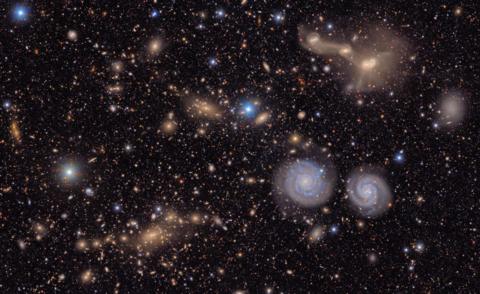
A huge cluster of galaxies including spiral galaxies in the vast Virgo cluster, which is about 100 billion times the size of the Milky Way.
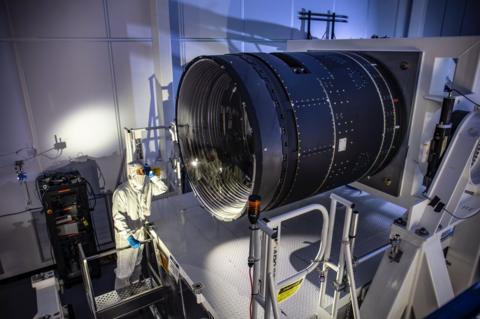
Vera Rubin's is 3,200-megapixel camera was built by the US Department of Energy's SLAC National Accelerator Laboratory

It achieves this through its unique three-mirror design. Light enters the telescope from the night sky, hits the primary mirror (8.4m diameter), is reflected onto the secondary mirror (3.4m) back onto a third mirror (4.8m) before entering its camera.

The mirrors must be kept in impeccable condition. Even a speck of dust could alter the image quality.

The high reflectivity and speed of this allow the telescope to capture a lot of light which Guillem Megias, an active optics expert at the observatory, says is "really important" to observe things from "really far away which, in astronomy, means they come from earlier times".

The camera inside the telescope will repeatedly capture the night sky for ten years, every three days, for a Legacy Survey of Space and Time.

At 1.65m x 3m, it weighs 2,800kg and provides a wide field of view.

It will capture an image roughly every 40 seconds, for about 8-12 hours a night thanks to rapid repositioning of the moving dome and telescope mount.

It has 3,200 megapixels (67 times more than an iPhone 16 Pro camera), making it so high-resolution that it could capture a golf ball on the Moon and would require 400 Ultra HD TV screens to show a single image.

"When we got the first photo up here, it was a special moment," Mr Megias said.

"When I first started working with this project, I met someone who had been working on it since 1996. I was born in 1997. It makes you realise this is an endeavour of a generation of astronomers."
It will be down to hundreds of scientists around the world to analyse the stream of data alerts, which will peak at around 10 million a night.

The survey will work on four areas: mapping changes in the skies or transient objects, the formation of the Milky Way, mapping the Solar System, and understanding dark matter or how the universe formed.

But its biggest power lies in its constancy. It will survey the same areas over and over again, and every time it detects a change, it will alert scientists.

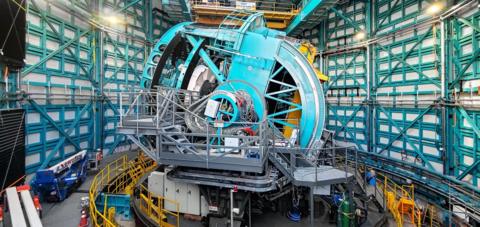
The Telescope Mount Assembly supports the camera and huge mirrors

Get our flagship newsletter with all the headlines you need to start the day. Sign up here.