Wubi News

China has millions of single men - could dating camp help them find love?

2025-06-21 09:00:14
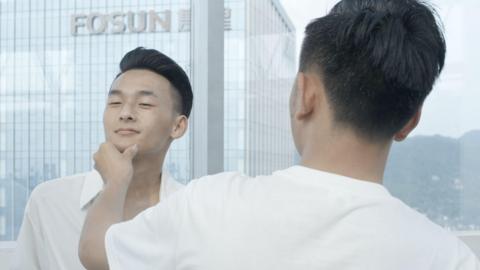
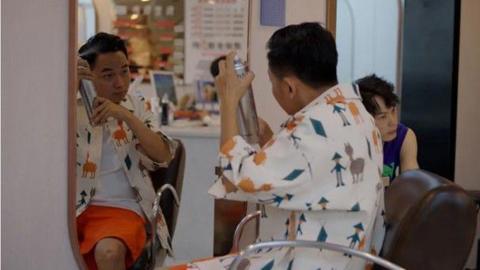
Li (left) is posed for a photograph by Hao, during his week-long course in how to attract women
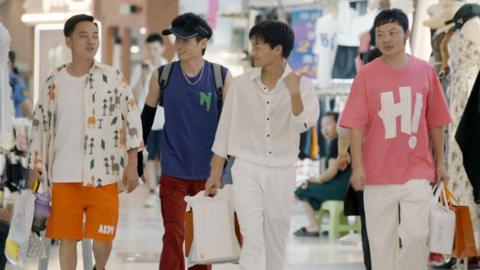
[L-R] The Dating Game sees Hao take Wu, Li and Zhou shop for clothes, which he chooses for them

Hao's three clients - Li, 24, Wu, 27 and Zhou, 36 - are battling the aftermath of China's one-child policy.

Set up by the government in 1980 when the population approached one billion, the policy was introduced amid fears that having too many people would affect the country's economic growth.

But a traditional preference for male children led to large numbers of girls being abandoned, placed in orphanages, sex-selective abortions or even cases of female infanticide. The result is today's huge gender imbalance.

China is now so concerned about its plummeting birth rate and ageing population that it ended the policy in 2016, and holds regular matchmaking events.

Wu, Li and Zhou want Hao to help them find a girlfriend at the very least.

He is someone they can aspire to be, having already succeeded in finding a wife, Wen, who is also a dating coach.

The men let Hao give them makeovers and haircuts, while he tells them his questionable "techniques" for attracting women - both online and in person.

But while everyone tries their best, not everything goes to plan.
Hao's dating techniques include "push and pull", where men give a compliment, say something insulting, and then make a joke of it

Hao constructs an online image for each man, but he stretches a few boundaries in how he describes them, and Zhou thinks it feels "fake".

"I feel guilty deceiving others," he says, clearly uncomfortable with being portrayed as someone he can't match in reality.

Du Feng thinks this is a wider problem.

"It's a unique China story, but also it's a universal story of how in this digital landscape, we're all struggling and wrestling with the price of being fake in the digital world, and then the cost that we have to pay to be authentic and honest," she says.

Hao may be one of China's "most popular dating coaches", but we see his wife question some of his methods.

Undeterred, he sends his proteges out to meet women, spraying their armpits with deodorant, declaring: "It's showtime!"

The men have to approach potential dates in a busy night-time shopping centre in Chongqing, one of the world's biggest cities.

It's almost painful to watch as they ask women to link up via the messaging app WeChat.

But it does teach them to dig into their inner confidence, which, up until now, has been hidden from view.

The men try to meet women in China's busy Chongqing
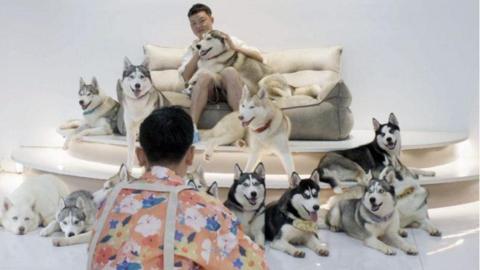
Hao photographs the men with beautiful dogs, saying the pictures will appeal to women

The film notably does not explore what life is like for gay men in China.

Du Feng agrees that Chines society is less accepting of gay men, while Dr Mu adds: "In China, heteronormativity largely rules.

"Therefore, men are expected to marry women to fulfill the norms... to support the nuclear family and develop it into bigger families by becoming parents."

Technology also features in the documentary, which explores the increasing popularity of virtual boyfriends, saying that over 10 million women in China play online dating games.

We even get to see a virtual boyfriend in action - he's understanding, undemanding and undeniably handsome.

One woman says real-life dating costs "time, money, emotional energy - it's so exhausting".

She adds that "virtual men are different - they have great temperaments, they're just perfect".

Dr Mu sees this trend as "indicative of social problems" in China, citing "long work hours, greedy work culture and competitive environment, along with entrenched gender role expectations".

"Virtual boyfriends, who can behave better aligned with women's expected ideals, may be a way for them to fulfil their romantic imaginations."

Du Feng adds: "The thing universally that's been mentioned is that the women with virtual boyfriends felt men in China are not emotionally stable."

Her film digs into the men's backgrounds, including their often fractured relationships with their parents and families.

"These men are coming from this, and there's so much negative pressure on them - how could you expect them to be stable emotionally?"

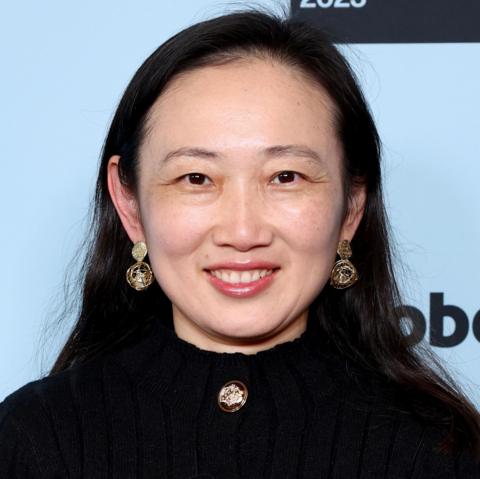
Violet Du Feng made The Dating Game to "challenge my own bias", after her Emmy-nominated documentary, Hidden Letters, in 2022, focused on women

Reuters reported last year that "long-term single lifestyles are gradually becoming more widespread in China".

"I'm worried about how we connect with each other nowadays, especially the younger generation," Du Feng says.

"Dating is just a device for us to talk about this. But I am really worried.

"My film is about how we live in this epidemic of loneliness, with all of us trying to find connections with each other."

So by the end of the documentary, which has many comical moments, we see it has been something of a realistic journey of self-discovery for all of the men, including Hao.

"I think that it's about the warmth as they find each other, knowing that it's a collective crisis that they're all facing, and how they still find hope," Du Feng says.

"For them, it's more about finding themselves and finding someone to pat their shoulders, saying, 'I see you, and there's a way you can make it'."

Screen Daily's Allan Hunter says the film is "sustained by the humanity that Du Feng finds in each of the individuals we come to know and understand a little better", adding it "ultimately salutes the virtue of being true to yourself".

Hao concludes: "Once you like yourself, it's easier to get girls to like you."

The Dating Game is out in selected UK cinemas this autumn.